Metalor
And Their Children After ThemMetalor is the steelworks that for generations organized life in Heillange and the surrounding valley: it drew in workers, fuel, and ore, sent metal out across Europe, and left a landscape marked by both industrial achievement and abandonment. Its closure did not end its influence. The mill endured as ruined infrastructure, as a remembered source of work and collective identity, and as the subject of competing visions for what the region might become.
Industrial Scale and the Valley
For a century, the Heillange blast furnaces consumed people, time, and raw materials on an immense scale. Carts carried fuel and mineral ores in along tracks; metal ingots left by train, then continued through rivers and streams on their way across Europe. Located at a crossroads, the mill depended on an extensive transport network. The same system that connected Heillange to distant markets also drained parts of the town: goods were deposited and sold by weight, while the region paid in labor and exhaustion.
The furnaces transformed ore into cast iron at three thousand degrees. Their operation was continuous, lasting through six generations and roaring even at night. Because stopping production was considered prohibitively expensive, workers could be pulled from their beds and families to keep the plant running. This rhythm made the mill more than a workplace: it governed time at home as well as time on the job, and tied generations of residents to its demands.
Work, Hierarchy, and Collective Memory
Metalor’s legacy passed through families. Manu’s father worked there from middle school until an accident; his uncles and grandfather also spent their working lives at the mill. The same history marked the Casatis and many other families in the valley. That inherited connection sits uneasily beside casual contempt for the region’s people: when a badly injured boy from Hennicourt was discussed, a sarcastic remark about people from there met no laughter from Manu, whose own family history made the mill’s human costs immediate.
The factory’s workforce was not treated as an equal body of workers. Malek Bouali had taken orders there for forty years, and his experience made clear that promotion and status were shaped by more than skill, seniority, or qualifications. Black and North African workers occupied the lowest tier; Poles, Yugoslavs, Italians, and the least competent French workers ranked above them. Higher positions effectively required being born in France. Even when a foreign worker became an apprentice or journeyman, suspicion followed him. Racial insults could become less overt with time, but the contempt behind them persisted. Bouali eventually earned a promotion, without escaping the hierarchy that had kept him in his place.
The mill’s labor system was sustained not only by production demands but by tacit rules and coercive practices. The appearance of an efficient allocation of jobs concealed inherited forms of discipline and institutional violence. In this setting, work offered a livelihood while sorting workers into unequal ranks, with immigrant laborers bearing the sharpest exclusion.
Metalor also shaped local solidarity. Luc Grandemange began paying union dues in 1963 and went on to serve in several union roles, becoming a familiar figure during the major Metalor strikes. He was not remembered chiefly as a theorist or negotiator: his jokes, teasing, and encouragement helped keep people connected through struggle. His funeral brought former Muslim coworkers and union veterans together, while making plain that a piece of their shared industrial history was being buried with him. That solidarity was not uncomplicated. Over time, Luc’s defense of workers turned toward a chauvinist account that blamed immigrants for unemployment, revealing how a labor identity built around shared hardship could also be recast in exclusionary terms.
Closure and the Uses of the Ruins
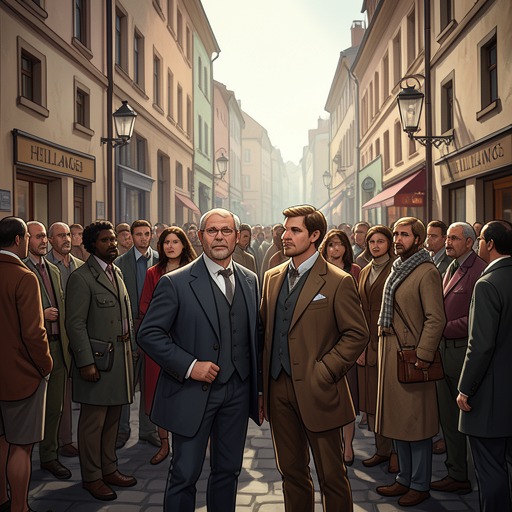
By the time Pierre Chaussoy addressed a gathering of local notables, Metalor’s closure had already been mourned for ten years. Chaussoy argued that the time for tears had passed and presented the sailing club as evidence that the valley could build a different future. He pointed to improvements at its campground and proposed an aquatic complex with a wave pool, waterslide, and twenty-five-meter lap pool. In place of an economy centered on production, he promoted leisure, the area’s summer weather, lake, forests, countryside, highway connections, and proximity to wealthier neighboring countries. He also expected public subsidies to help depressed regions attract visitors and investment.
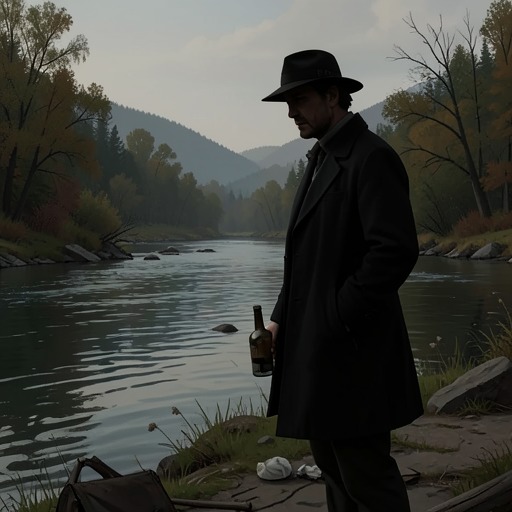
The speech found an audience weary of the prevailing language of crisis. Its optimism did not erase the scale of the loss: the gathering acknowledged that decades of economic devastation had changed work and French prosperity. Anthony Casati, passing through on an errand, stopped to listen. He was not wholly persuaded, but he recognized the burden of constant remembrance. For younger people who had not lived through the mill’s heyday, the celebrated industrial past could make any new enterprise seem laughable and any later success feel small. Metalor thus survived in memory not only as a source of pride, but as a standard against which the present struggled to measure itself.
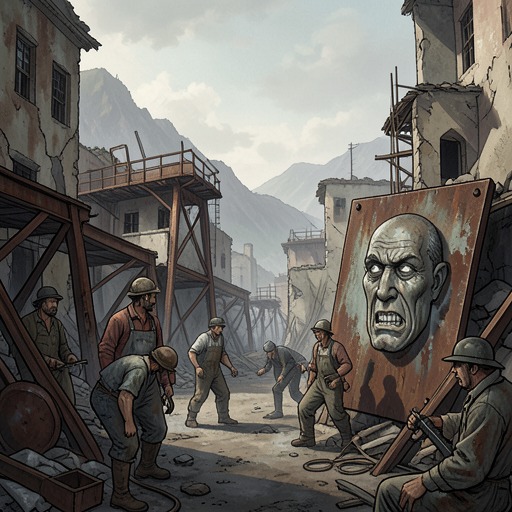
The physical remains made the break equally visible. What was left of the mill stood as reddish shapes behind a fence secured by a small padlock. One year, the site hosted an art opening; a legislative candidate suggested turning it into a theme park; children later damaged it with slingshots. These contrasting uses turned the ruins into a contested object: industrial relic, cultural venue, redevelopment opportunity, and unprotected playground. Overgrown tracks, fading billboards, and bullet-riddled street signs extended the impression of a landscape in which the infrastructure of the old economy remained after its purpose had gone.
Afterlives and Narrative Significance
Metalor’s afterlife included the work of dismantling the built environment it had helped create. The old mills owned dozens of worker row houses and larger homes for engineers and bosses. After the shutdown, the properties were neglected until the holding company accepted responsibility for their condition and hired Solodia, an industrial cleanup firm, for a contract expected to provide at least three years of work. Hacine Bouali took a temporary job on that account. He and other workers entered buildings with buckets, sledgehammers, and crowbars, tore down plaster and brick walls, removed lead pipes, and hauled rubble to dump trucks. The destruction could initially feel like a demolition game, but the dust, masks, heavy lifting, and repeated clearing made it another form of industrial labor. The mill’s closure had not removed work from the valley so much as changed its object: workers were now paid to dismantle the housing left behind.
Even after the buildings stood empty, the furnace remained a commanding presence in the town’s everyday geography. During the celebrations after France reached the World Cup semifinals, Anthony went outside a crowded bar and urinated against the fence around the Metalor mill. In the quiet street, the blast furnace weighed on him as he looked up and traced patterns on the bricks. Elsewhere, driving through Heillange at night, he passed the enormous steelworks among the familiar landmarks of a life spent in the valley. Metalor belongs to the story not simply as a closed employer, but as an enduring structure of memory: it once organized production and family time, and afterward its ruins continued to frame the limits, losses, and imagined futures of the place around it.